

Toggle Pliers vs Toggle Clamps: When to Use Each
Toggle pliers and toggle clamps use the same over-center locking principle, but they do different jobs. Toggle pliers are hand-held and portable: they squeeze parts together anywhere on the shop floor. Toggle clamps bolt to a fixture and hold every part in the same position, cycle after cycle.
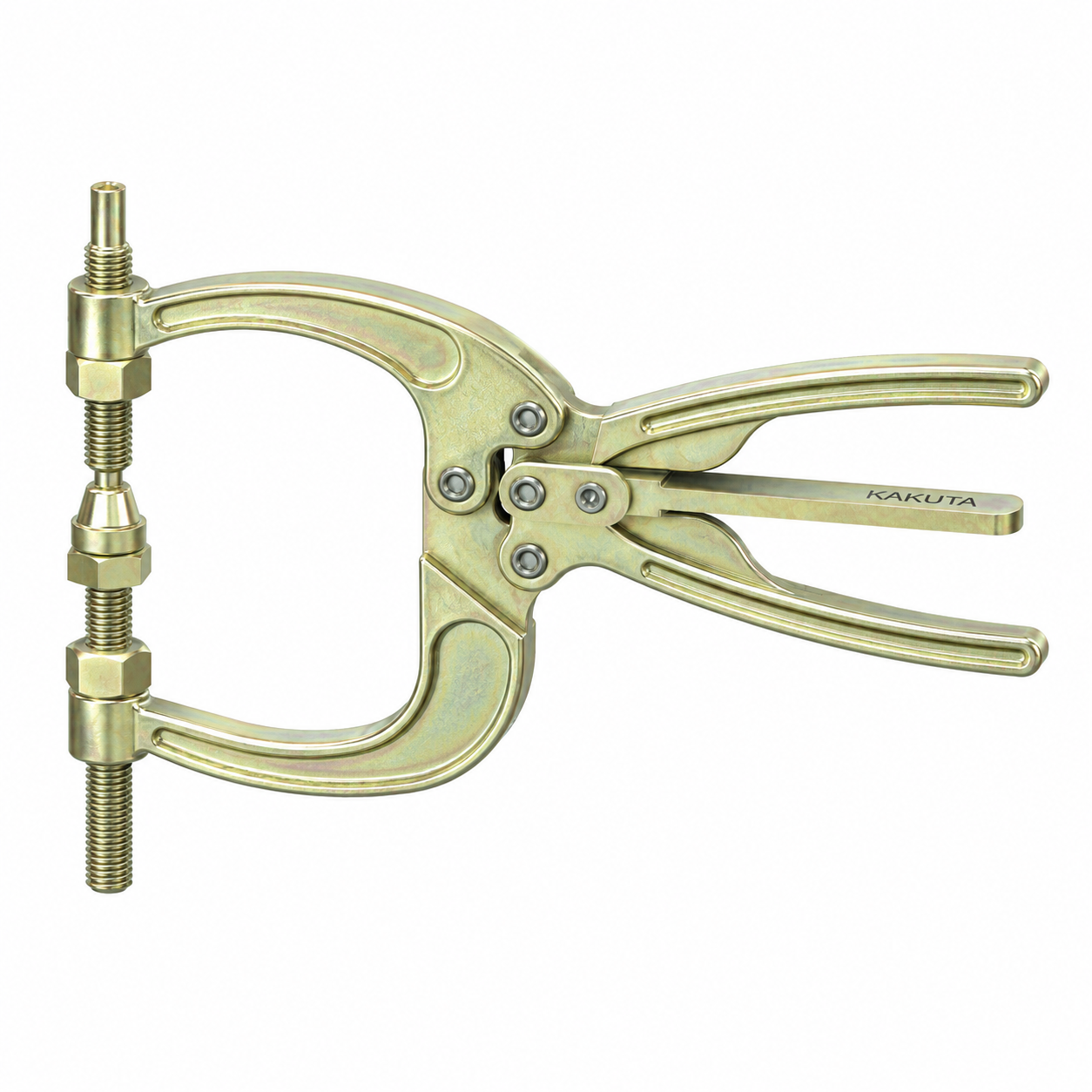
Both tools lock by pushing a linkage just past its center point. Once locked, the load on the jaws or spindle cannot force the tool open, so it holds with no ongoing effort from the operator. If you want the mechanics in detail, see how the over-center mechanism works →.
The difference is where the tool lives. A toggle clamp is a fixture component. A toggle plier is a hand tool that the operator carries to the part. This guide explains when each one is the right choice, and how to pick a model from the Kakuta SA series of toggle clamping pliers.
What Is a Toggle Plier?
A toggle plier (also called a toggle clamping plier or locking plier clamp) has two jaws operated by a pair of handles. Squeezing the handles drives the toggle linkage over center and locks the jaws on the work. Adjustable spindles on the jaws set the clamping position to suit the part thickness.
- Portable. Nothing is bolted down. The plier goes wherever the part is.
- Squeeze action. The jaws close toward each other, so the plier clamps two surfaces together, such as overlapping sheets, a flange to a bracket, or a part to a table edge.
- Fast release. Several SA models open with a two-way release lever, so the operator can unlock them with one hand.
What Is a Toggle Clamp?
A toggle clamp is bolted or welded to a fixture plate, jig or machine table. It presses the part against fixed locators and holds it there while the work is done. Our pillar guide, What Is a Toggle Clamp? →, covers the basics, and types of toggle clamps → explains hold-down, push-pull and latch styles.
- Fixed position. The clamp always closes in the same place, so every part is held the same way.
- Built for repeat work. In a production fixture, loading and unloading is one handle motion per clamp.
- Many styles. Vertical and horizontal hold-downs, push-pull and latch clamps cover different holding directions and clearances.
Toggle Pliers vs Toggle Clamps at a Glance
| Factor | Toggle pliers (SA series) | Toggle clamps |
|---|---|---|
| Mounting | None: hand-held and portable | Bolted or welded to a fixture, jig or table |
| Clamping action | Two jaws squeeze toward each other | Spindle presses the part against a fixed surface or locator |
| Repeatability | Depends on where the operator places the plier | Same position and force every cycle |
| Best for | Repairs, prototypes, fit-up, one-off and low-volume jobs, large parts | Production fixtures, welding jigs, machining and assembly |
| Setup time | None: adjust the spindle and clamp | Fixture design and mounting required once |
| Locking | Over-center, with a release lever on several models | Over-center, with the handle used to release |
When Should You Use Toggle Pliers?
Choose toggle pliers when the part, not the fixture, sets the clamping position, or when building a fixture is not worth it for the job.
- Low-volume and one-off work. Prototypes, repairs and short runs where a dedicated fixture would cost more than the job.
- Fit-up and tacking. Holding two sheets, flanges or brackets together while they are tacked, drilled or riveted.
- Large or awkward parts. Parts too big to fit a fixture, where the clamp has to come to the work.
- Temporary holding during assembly. Holding a component in place for a short time while another one is fastened.
- Confined areas. A narrow-jaw plier such as the SA 350 can reach where a fixture-mounted clamp has no room to mount.
When Is a Fixture-Mounted Toggle Clamp the Better Choice?
Choose a toggle clamp when you need every part held in exactly the same place, or when the same operation runs many times a shift.
- Production runs. A fixed clamp removes the variation that comes from placing a plier by hand.
- Accuracy-critical work. Machining, inspection and welding fixtures depend on locators and clamps working together.
- Operator ergonomics. A fixed clamp needs one motion to close and one to open, with no tool to pick up and put down.
- Many clamping points. A fixture can carry several clamps that all close the same way every time.
For fixture work, browse vertical handle clamps → and horizontal handle clamps →.
Many shops use both. Toggle pliers handle repairs, prototypes and the first few parts. Once a job moves into regular production, the clamping points are moved into a fixture with mounted toggle clamps.
The Kakuta SA Series: Toggle Clamping Pliers
The SA series covers nine models, from compact pliers for small squeeze jobs to a heavy-duty plier with dual spindles. Holding capacities and weights below are from the Kakuta USA product pages.
| Model | Holding capacity | Weight | Key features |
|---|---|---|---|
| SA 150 | 90 kg | 157 g | Forged steel, for small jobs requiring squeeze action. One vinyl coated spindle assembly. |
| SA 155-2 | 90 kg | 157 g | Same as SA 150, with two vinyl coated spindle assemblies. |
| SA 250 | 160 kg | 253 g | Forged steel, medium-range holding pressure in a compact size. One hex head spindle assembly. |
| SA 255-2 | 160 kg | 253 g | Same as SA 250, with two hex head spindle assemblies. |
| SA 350 | 318 kg | 546 g | Compact, narrow-jaw forged steel plier for confined areas. Two-way release lever. One hex head spindle assembly. |
| SA 450 | 318 kg | 596 g | The most universal plier in the line. Two-way release lever. Swivel foot assembly. |
| SA 455-2 | 318 kg | 596 g | Same as SA 450, with two hex head spindle assemblies. |
| SA 550 | 318 kg | 659 g | Forged steel for heavy-duty use. Dual spindles centralize the jaws on the workpiece. One swivel foot and one hex head spindle assembly. Two-way release lever. |
| SA 2 | 400 kg | 518 g | Forged high-carbon steel jaw that moves 90°. Red embossed vinyl handle grip and hex head spindle. |
How to choose an SA model
- Light, small parts: SA 150 or SA 155-2.
- General shop work in a compact size: SA 250 or SA 255-2.
- Tight spaces: SA 350, with its narrow jaw.
- An all-round plier with a swivel foot: SA 450.
- Heavy-duty work where the part must be centered between two spindles: SA 550.
- The highest listed holding capacity, with a 90° jaw movement: SA 2.
- Need spindles on both jaws? Choose a “-2” model (SA 155-2, SA 255-2, SA 455-2), which comes with two spindle assemblies.
Compare the full range on the toggle clamping pliers page →.
Cross-reference for existing users
If your shop already uses another brand, these are the nearest listed equivalents from Kakuta's cross-reference. Check dimensions and capacity before substituting.
| Kakuta | Destaco | Carr Lane |
|---|---|---|
| SA 2 | 325 | CL-325-PL-S |
| SA 150 | 424 | CL-50-PL |
| SA 155-2 | 424-2 | CL-50-PL-2 |
| SA 250 | 441 | CL-150-PL |
| SA 255-2 | 441-2 | — |
| SA 350 | 461 | — |
| SA 450 | 462 | CL-254-PL |
| SA 455-2 | 462-2 | CL-254-PL-2 |
| SA 550 | 463 | CL-454-PL |
Practical Tips for Using Toggle Pliers
- Set the spindle first. Adjust the spindle to the part thickness before closing, so the plier locks over center with firm, even pressure.
- Stay within the rated holding capacity. If the load approaches the rating, move up to a larger model or add a second plier.
- Clamp on solid material. Place the jaws where the part is backed and can't bend under the squeeze.
- Use the release lever. On models that have one, open the plier with the release lever rather than by forcing the handles.
- Keep it clean. Wipe spatter and debris off the spindle threads and keep the pivots lightly lubricated. Our maintenance guide → covers the same care for pliers and clamps.
Conclusion
Toggle pliers and toggle clamps lock the same way but serve different purposes. Use toggle pliers when the job is short, the part is large or awkward, or the clamp has to come to the work. Use fixture-mounted toggle clamps when every part must be held identically and the operation repeats. Within the SA series, choose by holding capacity, jaw style and spindle arrangement, from the compact SA 150 to the heavy-duty, dual-spindle SA 550.
Frequently Asked Questions
What is the difference between toggle pliers and toggle clamps?
Both lock using an over-center linkage. Toggle pliers are hand-held tools whose two jaws squeeze parts together, and they need no mounting. Toggle clamps are bolted or welded to a fixture and press the part against fixed locators, so they hold every part in the same position.
Are toggle pliers the same as locking pliers?
They work on the same over-center principle. Toggle clamping pliers such as the Kakuta SA series are built for workholding, with adjustable spindles, swivel feet or hex head spindle assemblies, and, on several models, a two-way release lever.
When should I use toggle pliers instead of a fixture?
Use toggle pliers for prototypes, repairs, short runs, fit-up and large parts that won't fit a fixture. When the same part is produced repeatedly and must be held in exactly the same place, a fixture with mounted toggle clamps is the better choice.
What is the holding capacity of Kakuta SA toggle pliers?
Listed holding capacities are 90 kg for the SA 150 and SA 155-2, 160 kg for the SA 250 and SA 255-2, 318 kg for the SA 350, SA 450, SA 455-2 and SA 550, and 400 kg for the SA 2.
What does the "-2" mean in SA 155-2, SA 255-2 and SA 455-2?
The "-2" models are identical to their base models (SA 150, SA 250 and SA 450) but are supplied with two spindle assemblies instead of one.
Find the right plier for the job
Explore the KAKUTA SA series of forged steel toggle clamping pliers, from compact squeeze-action models to the heavy-duty, dual-spindle SA 550. Precision workholding since 1959.
Explore the SA series →